The Situation
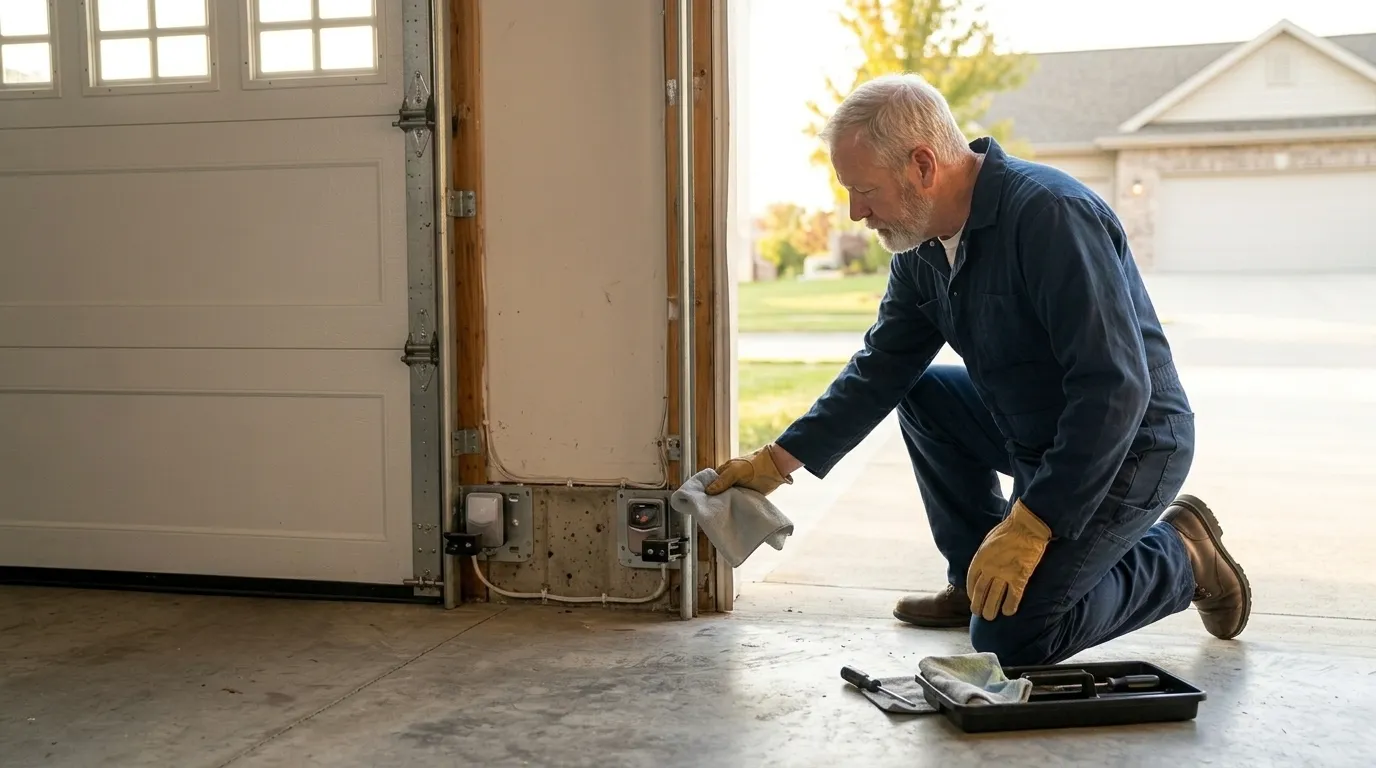
The two photo-eye sensors mounted a few inches off the garage floor are the part of the opener system most likely to go out of alignment, and in this area that happens more than you'd think. Most garages here sit on slabs poured somewhere between 1938 and 2005, with the bulk of that stock going up in the 1960s and 70s. Older concrete doesn't move as a single stable block the way a modern reinforced pad does. Small shifts in the slab edge, even a fraction of an inch, tilt the bracket the sensor is bolted to, and the beam that used to line up dead-center on the opposite eye now points a hair off. The door still closes fine some days and refuses to close, or reverses halfway down, on others. Homeowners usually blame the opener logic board first, because that's the part with the blinking light. Nine times out of ten the board is fine. It's the eyes that moved, not the brain. On a call like this, we're looking at the brackets, the wire runs to each sensor, and whether the slab itself has settled unevenly on one side of the opening before we touch anything electronic.
What Local Conditions Do
This is a cold-climate area with severe winters, and that matters more for sensor alignment than most people expect. Every freeze-thaw cycle pushes and pulls at the edge of a concrete slab, and the sensor brackets are almost always lag-bolted right into that edge or into the wood jamb sitting on it. A slab that was poured in the median build year of 1972 wasn't designed with the reinforcement standards used today, so it has more room to shift a little each winter. Across the many neighborhoods that make up this service area, most of them built out in the same 1960s-70s wave, the pattern repeats: the sensor problem shows up on nearly identical hardware, in nearly identical spots, because the houses went up the same way and sit through the same winters. It isn't that the sensors themselves are bad. It's that the surface they're bolted to keeps moving under them, a few thousandths of an inch at a time, until the beam finally misses.
Leaving It Alone
A drifted sensor isn't cosmetic. It's a safety system, and when it stops seeing its partner correctly, the opener is supposed to refuse to close the door rather than risk closing on something in the way. That's the system working as intended, even though it feels like a malfunction when you're standing in the driveway at night. The bigger risk is when a sensor drifts just enough to still connect most of the time, so the door closes normally on 90 percent of tries and only fails when something's actually in the beam path. That's the scenario nobody wants. In a stock of houses this old, on slabs that move every winter, a bracket that was aligned last year isn't guaranteed to be aligned this year. Checking it isn't a big job. Ignoring it for a few seasons in a row, on a slab that keeps settling, is how a small adjustment turns into a bracket replacement or a full sensor swap later on.